
| YEAR | CONTRIBUTIONS |
|---|---|
| 2008 | $11,475 |
| 2009 | $11,475 |
| 2010 | $11,475 |
| 2011 | $12,750 |
| 2012 | $12,750 |
| 2013 | $12,750 |
| 2014 | $12,750 |
| 2015 | $12,750 |
| 2016 | $15,300 |
| 2017 | $15,300 |
| 2018 | $15,300 |
| 2019 | $15,300 |
| 2020 | $15,300 |
| 2021 | $15,300 |
| 2023 | $15,300 |
| 2024 | $15,300 |
| 2025 | $15,300 |
| Total | $235,875 |
SRS Fund
I started my SRS Fund in 2008 after decidign to participate in the Supplementary Retirement Scheme introduced by the Singapore government. At the time, it felt like a sensible way to combine tax efficiency with long term investing, but more importantly, it marked the beginning of a disciplined decades long commitment to retirement planning.
Contributions made to the SRS are tax deductible subjected to an annual cap. Over the years, I have consistently contributed the maximum allowable amount, staying within the guidelines set by the authorities. What began as a tax decision gradually evolved into a core part of my long term investment journey.
Since inception the SRS Fund has delivered a compounded return of 9.7%. The table below shows its performance over the 1-year, 3-year and 5-year periods. While short term returns naturally fluctuate, the longer term trend has reinforced my belief in patience, consistency and staying invested.
| Trailing from 2024 | % Return |
|---|---|
| 1 Year CAGR | 26.1% |
| 3 Year CAGR | 17.2% |
| 5 Year CAGR | 13.5% |
| CAGR Since Inception | 9.7% |
In total, $235,875 has been contributed to the SRS Fund since 2008, with annual contributions details in the table on the left. As at 31st December 2025, the fund’s value reached $608,030 – a figure that still feels a little surreal when I reflect on how it all started with small, yearly contributions.
The portfolio is largely invested in Singapore listed companies with solid business fundamentals. This reflects the constraint of the SRS during those earlier years as well as my preference for business I understand, generate steady cash flows and can hold through market cycles. Over time, the focus has increasingly shifted toward stability and income rather than chasing short term gain.
The fund will mature when I reach the age of 62, after which I will have a 10 year window to begin withdrawal. Under current rules, 50% of each withdrawal is tax free, while the remaining portion is taxed at prevailing personal income tax rates. Withdrawals can be made in either cash or shares, providing some flexibility in managing income and taxes.
Looking ahead, assuming a conservative 8% annual return and continued maximum contribution, the SRS Fund could exceed $1.8m by retirement age. If withdrawals are spread over ten years – around $250,000 per year – the taxable portion would be roughly $125,000 annually. Hopefully by then, tax brackets will have adjusted upwards, reducing the overall tax burden.
Realistically, if I remain employed until retirement, the tax efficiency of additional SRS contributions may diminish at the withdrawal stage. Still until it becomes clear that further contributions no longer make sense, I intend to continue. The discipline of forced, long term investing has proven valuable beyond just tax considerations.
I will continue to share this journey with regular monthly updates, documenting both progress and decisions along the way. Alongside that, I’ll share market observations as I guide the SRS Fund towards its ultimate goal of building a reliable and sustanable stream of dividend income for retirement.
LATEST POSTS
-
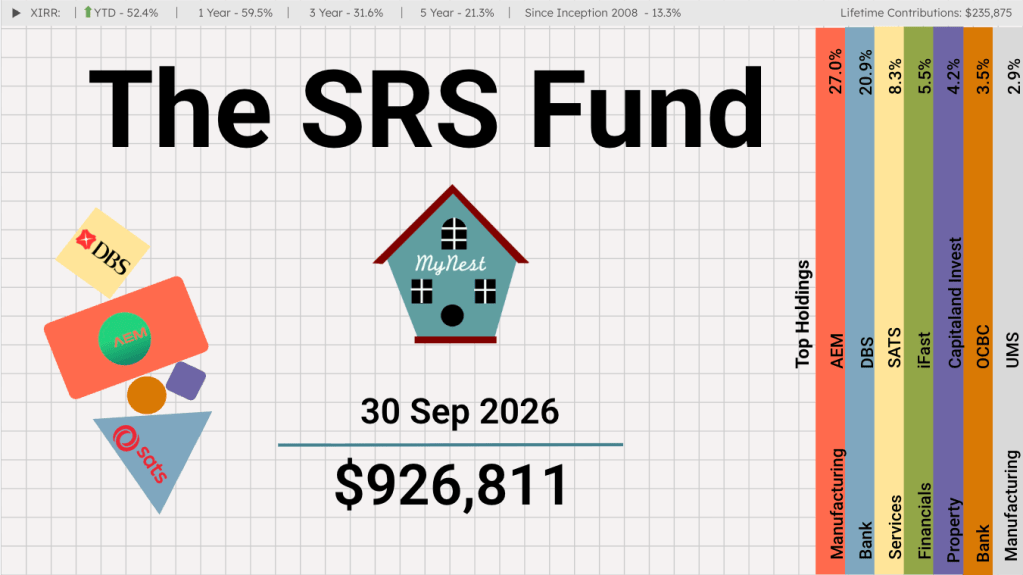
The SRS Fund Sep 2026
Sep brought a modest recovery in the SRS Fund, but it also left me thinking more carefully about how much of Singapore’s current economic and market strength is connected to the AI investment cycle.
-
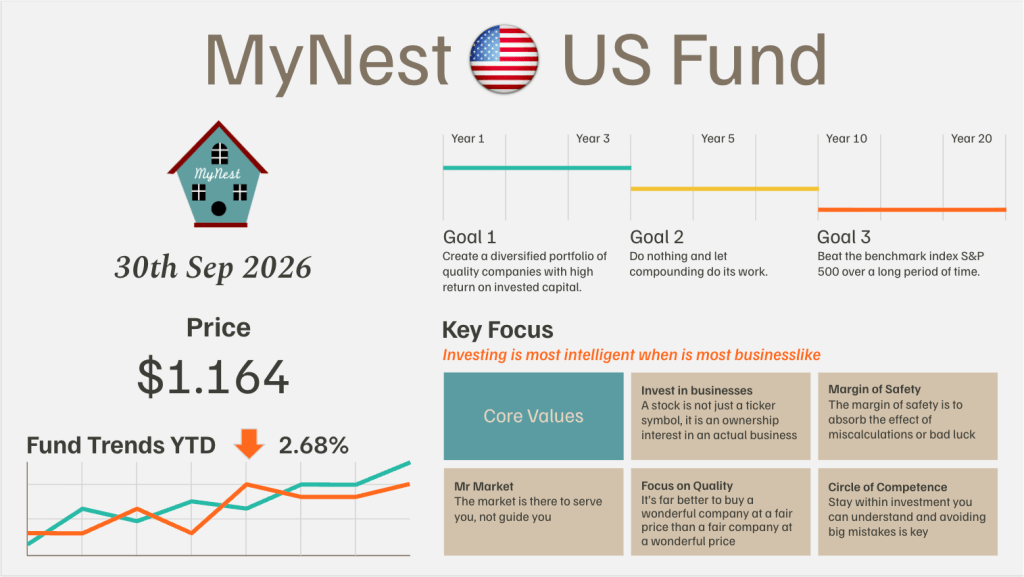
MyNest US Fund Sep 26
The month of Sep brought together two developments that matter to our portfolio: Further progress in the field of AI and a sharp increase in long-term interest rates.
-

The SRS Fund Aug 2026
Aug’s economic update provided another reminder of how closely Singapore has become connected to the global investment in AI and semiconductors.
-
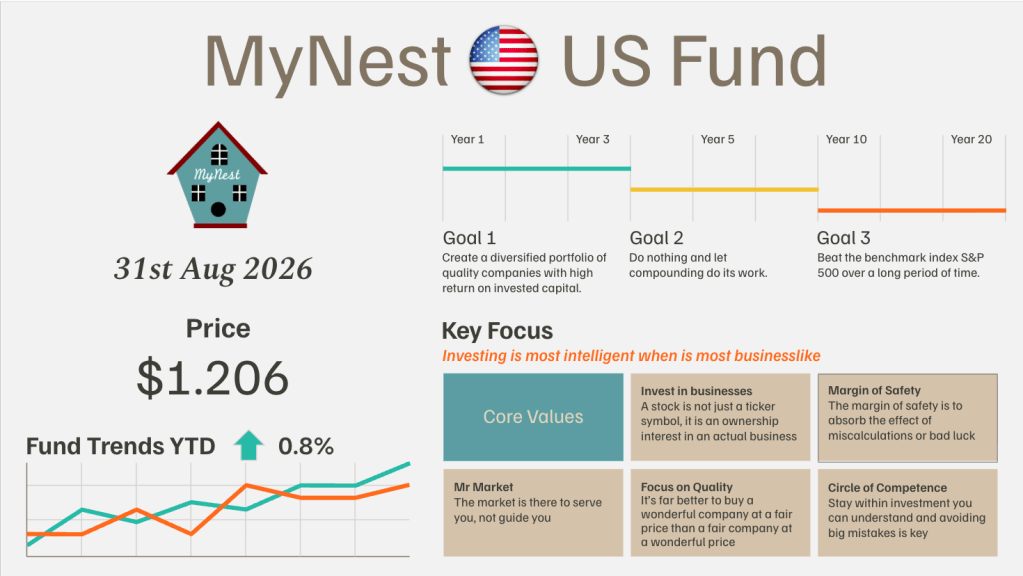
MyNest US Fund Aug 26
The idea behind the “SaaSpocalypse” was simple: if artificial intelligence could write software, generate content and complete business tasks, what would happen to the software companies charging customers to do those things?
-
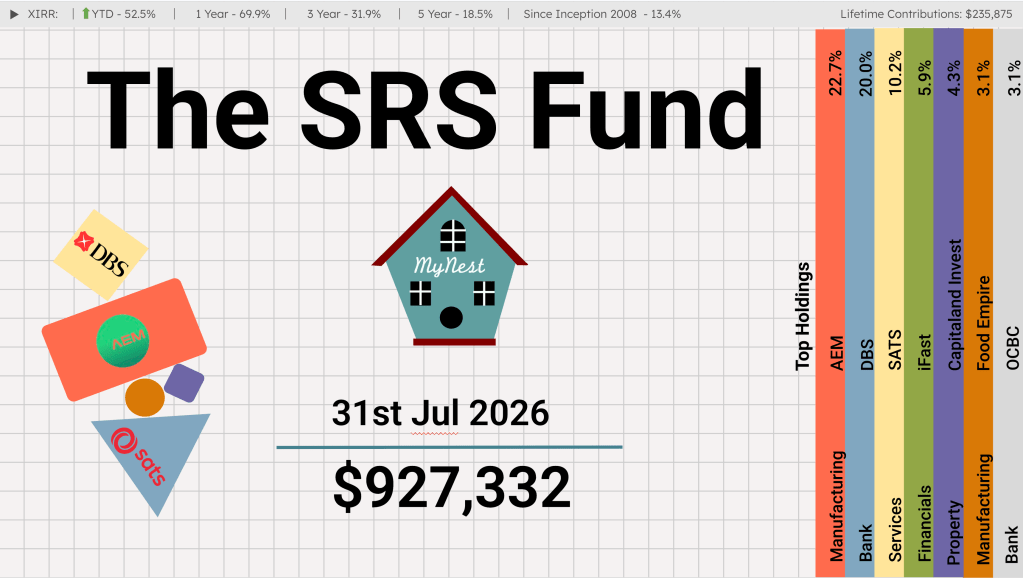
The SRS Fund Jul 2026
For much of 2026, the market’s attention has been firmly fixed on AI, semiconductors and anything connected to the massive build-out in computing infrastructure.
-
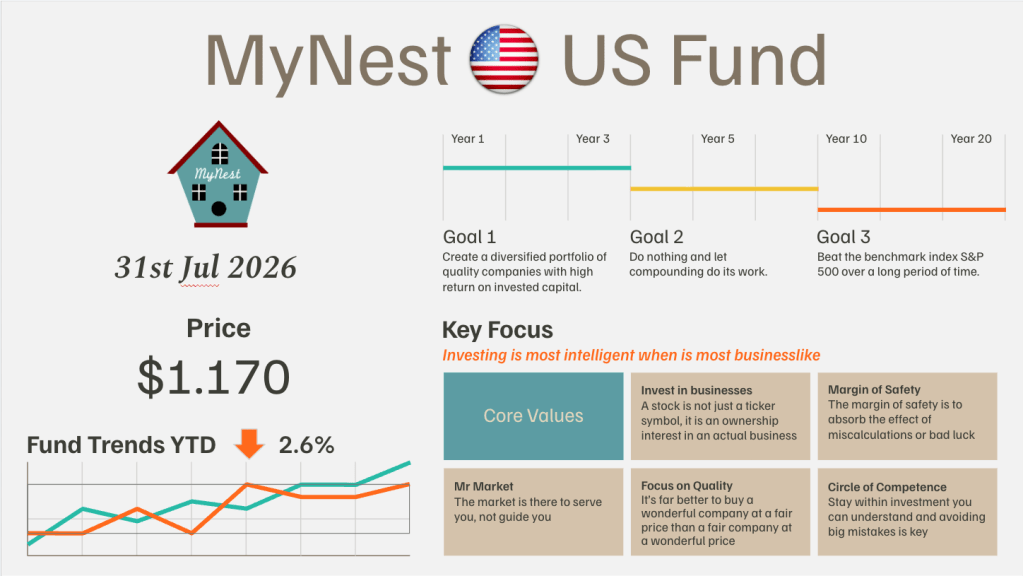
MyNest US Fund Jul 26
After spending a long period watching the artificial intelligence infrastructure build-out from the sidelines, we finally decided to join the party—albeit cautiously.

