
Dear Investors,
After spending a long period watching the artificial intelligence infrastructure build-out from the sidelines, we finally decided to join the party—albeit cautiously.
Volatility during July provided us with a small window of opportunity to initiate positions in two of the most important companies supporting the AI ecosystem: Nvidia and Taiwan Semiconductor Manufacturing Company, or TSMC.
These two companies should be familiar to most investors. Nvidia’s GPUs have become the dominant computing hardware used to train and run many of today’s most advanced AI models. TSMC, meanwhile, is the world’s leading semiconductor foundry, possessing the advanced manufacturing and packaging capabilities required to produce these chips.
The semiconductor sector—including companies such as Nvidia, Micron, AMD and Intel—has been one of the strongest drivers of market performance over the past year. Our limited exposure to this area has contributed meaningfully to our underperformance against the S&P 500.
Our decision to invest in Nvidia and TSMC does not represent a change in our investment philosophy, nor is it an attempt to chase the market after a strong rally. These are deliberately small starter positions that give us a foot in the door while allowing us to continue studying the businesses, monitoring their valuations and adding only when the prospective returns are sufficiently attractive.
The MyNest US Fund closed July at $1.170, representing a gain of approximately 4.1% for the month. This was a welcome recovery, although our focus remains firmly on long-term compounding rather than short-term market movements.
Alphabet’s Blowout Quarter
Alphabet, our largest holding at 18.56% of the fund, recently announced an exceptionally strong second quarter—and it did not disappoint.
Total revenue increased 24% to US$119.8 billion, despite being measured against an already substantial base. Google Search revenue grew 17%, while Google Cloud revenue accelerated by an extraordinary 82% to US$24.8 billion.
More importantly, Google Cloud operating income rose from US$2.8 billion to US$8.8 billion. This provides early evidence that Alphabet’s enormous investment in AI infrastructure is already generating meaningful revenue and operating profit.
Another particularly interesting disclosure was that Google Cloud now generates product revenue from the sale of TPU systems.
Google is therefore no longer relying solely on Nvidia GPUs to provide computing capacity. Its internally designed Tensor Processing Units are increasingly becoming both a competitive advantage for Google Cloud and a commercial product that can be sold directly to customers.
The headline increase in Alphabet’s earnings per share should, however, be viewed with some caution. The quarter included approximately US$99 billion of gains on equity securities, which added US$6.26 to diluted earnings per share.
The more meaningful indicators of the strength of Alphabet’s underlying business were the continued growth in Search, the acceleration in Google Cloud, the significant improvement in Cloud profitability and the expansion of the group’s operating margin.
The Trillion Dollar AI Build-Out
Together with Amazon, Microsoft, Meta and the other major hyperscalers, Alphabet is participating in an AI infrastructure build-out of unprecedented scale.
Goldman Sachs estimates that hyperscaler capital expenditure could reach approximately US$1.1 trillion in 2027, compared with current market estimates of around US$920 billion. In a more bullish scenario, annual spending could reach as much as US$1.4 trillion.
The scale of this investment is already placing pressure on free cash flow. Alphabet generated quarterly operating cash flow of US$39.1 billion, but capital expenditure reached almost US$44.9 billion. As a result, free cash flow for the quarter turned negative at approximately US$5.9 billion.
However, trailing 12-month free cash flow remained positive at more than US$53 billion. Alphabet’s underlying businesses continue to produce substantial cash, but an increasing proportion of that cash is being reinvested into data centres, chips, networking equipment and global computing capacity.
One of the characteristics of a great business is its ability to reinvest large amounts of incremental capital at attractive rates of return. The hyperscalers clearly believe that the opportunities created by AI justify reinvesting almost every dollar they generate—and, increasingly, supplementing their internally generated cash with additional debt and equity capital.
Alphabet itself raised US$49.6 billion through a combination of common shares and mandatory convertible preferred shares during the quarter. It also issued senior unsecured notes with net proceeds of US$20.3 billion.
The early results from Google Cloud suggest that these investments are already producing meaningful returns. Nevertheless, the ultimate economics of the AI build-out will depend on whether future revenue and cash flow can grow quickly enough to justify the extraordinary amount of capital being committed.
This is something we will continue to monitor closely.
Portfolio Activity
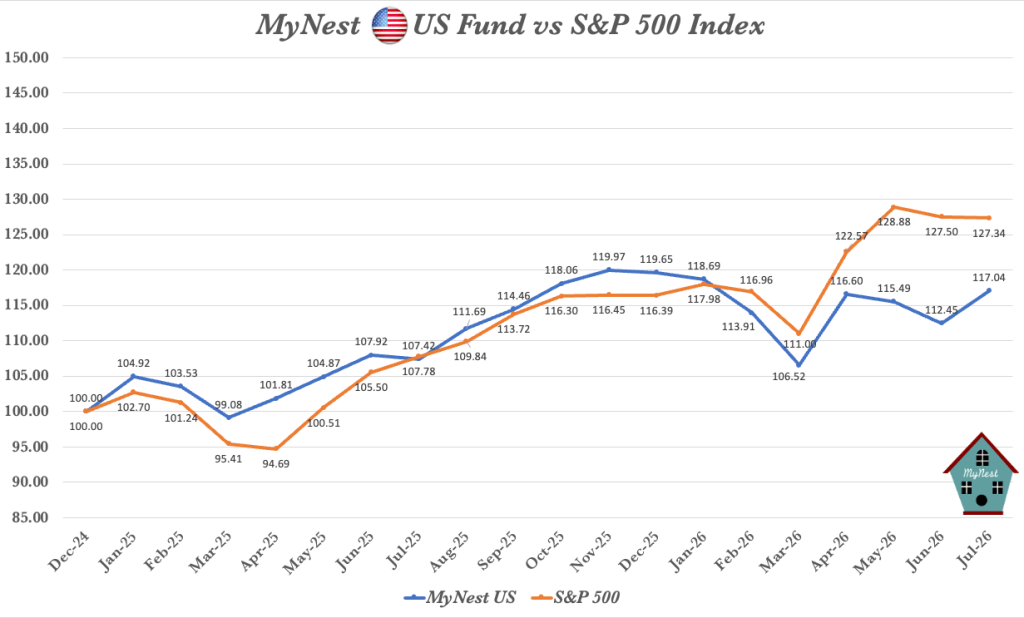
The MyNest US Fund staged a strong recovery in July, rising 4.1% from 112.45 to 117.04, while the S&P 500 was broadly unchanged for the month. This helped narrow part of the performance gap that had widened during the second quarter.
Since inception in December 2024, the fund has delivered a cumulative return of approximately 17.0%, compared with 27.3% for the S&P 500. Most of this relative underperformance emerged after March 2026, when the S&P 500 rebounded more sharply, supported by strong gains among the large technology and AI-infrastructure companies.
MyNest US Fund participated less fully in this rebound because of its limited exposure to semiconductors and other major beneficiaries of the AI capital-spending cycle. July’s additions to Nvidia, TSMC and Meta were intended to address part of this portfolio gap while maintaining disciplined position sizing.
Although July’s performance was encouraging, one month does not establish a trend. The S&P 500 continues to lead by approximately 10 percentage points since inception. Our priority is therefore not to close this gap through short-term risk-taking, but to improve the portfolio’s long-term earning power by owning businesses that can compound capital at attractive rates of return.
The recent recovery demonstrates that performance can improve quickly when the underlying businesses execute well. Nevertheless, sustained outperformance will ultimately depend on business fundamentals, valuation discipline and the returns generated by the fund’s portfolio decisions over a much longer period.
Portfolio Activity
During July, we added to our positions in Nvidia, TSMC and Meta. We also initiated a small position in the Pabrai Wagons ETF, or WAGN.

WAGN is a focused, actively managed global equity ETF managed by Mohnish Pabrai. The fund maintains a concentrated portfolio and invests in businesses that it believes are mispriced, overlooked or unloved by the broader market.
Its portfolio is highly complementary to the MyNest US Fund. Through WAGN, we gain exposure to companies and markets that we would be unlikely to invest in directly, including Reysas in Türkiye, Warrior Met Coal, TAV Airports and several financial-services and energy-related businesses.
WAGN has very limited overlap with the S&P 500 and therefore provides us with a different source of potential returns from our existing portfolio.
I view WAGN as a small global value allocation rather than an alternative investment. It broadens the fund’s exposure to less familiar markets and industries while remaining consistent with our preference for concentrated portfolios, capable capital allocators and businesses trading below their estimated intrinsic value.
At approximately 0.98% of the MyNest US Fund, the position is appropriately sized given WAGN’s concentrated structure, exposure to cyclical businesses and investments in less familiar markets.
Segment Chart

The portfolio remains diversified across multiple sectors, with Advertising & Cloud as the largest segment at 24.2%, mainly driven by Alphabet. Insurance, Finance and Transport together provide balance, while the 8.9% cash position gives us flexibility to take advantage of future opportunities. Our semiconductor exposure remains modest at 2.8%, reflecting the cautious initial positions established in Nvidia and TSMC.
Closing Thoughts
July represented a small but meaningful evolution in the MyNest US Fund.
Our lack of direct exposure to semiconductor and AI-infrastructure companies has clearly affected our performance relative to the S&P 500. The appropriate lesson, however, is not that we should purchase every company that has performed well.
Instead, we must remain intellectually honest, revisit our assumptions when the facts change and gradually expand our circle of competence.
The additions of Nvidia and TSMC are therefore not an abandonment of value-investing principles. They are an attempt to apply those same principles to two exceptionally important businesses while controlling risk through valuation discipline and prudent position sizing.
Our core objective remains unchanged: to own high-quality businesses with durable competitive advantages, capable management teams, strong balance sheets and long opportunities to reinvest capital at attractive rates of return.
There will inevitably be periods when this approach falls behind the market. Our responsibility is to learn from those periods without allowing short-term performance pressure to override investment discipline.
Lastly, I would like to thank you for your continued trust and support.
-

The SRS Fund Aug 2026
Aug’s economic update provided another reminder of how closely Singapore has become connected to the global investment in AI and semiconductors.
-
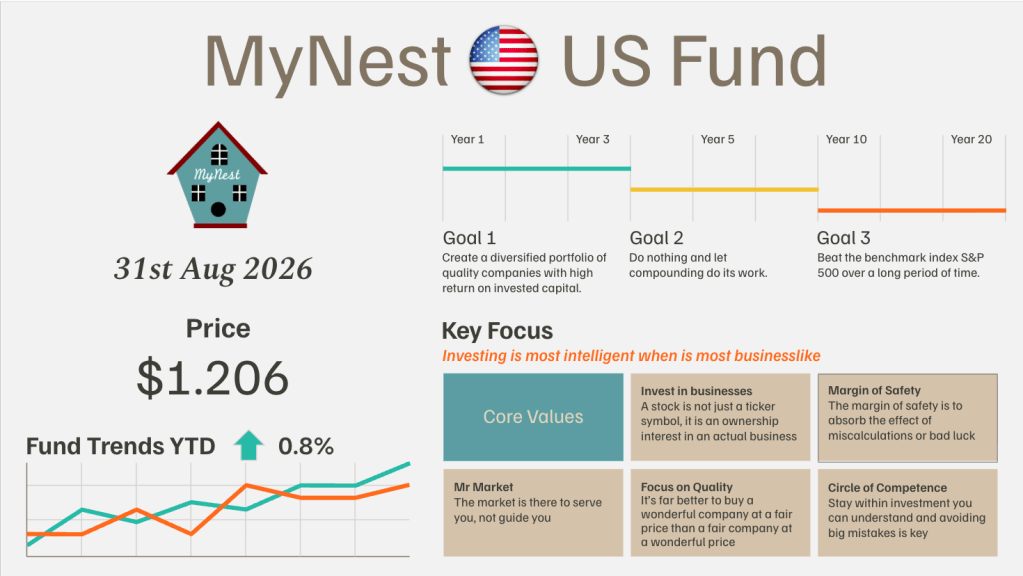
MyNest US Fund Aug 26
The idea behind the “SaaSpocalypse” was simple: if artificial intelligence could write software, generate content and complete business tasks, what would happen to the software companies charging customers to do those things?
-
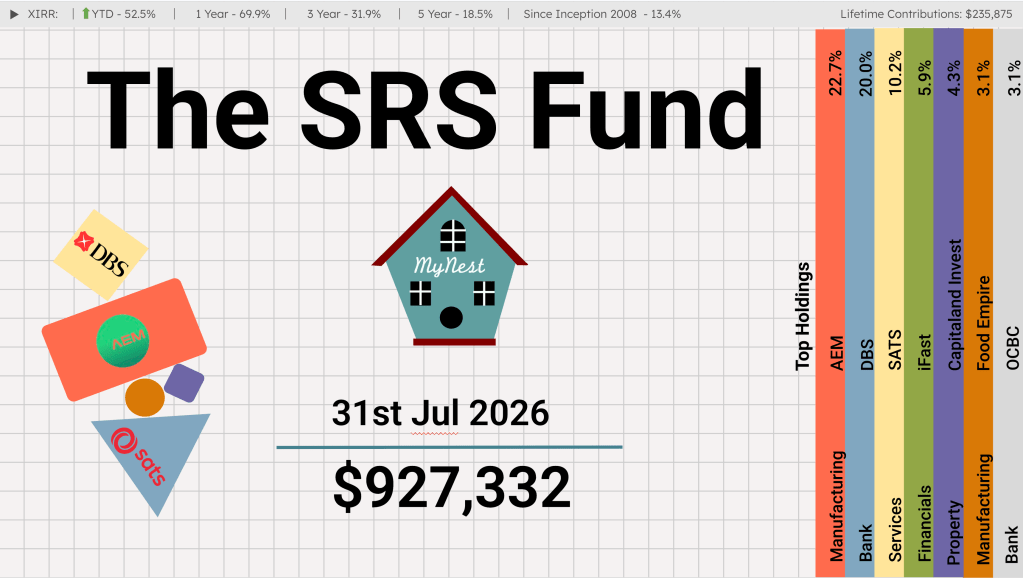
The SRS Fund Jul 2026
For much of 2026, the market’s attention has been firmly fixed on AI, semiconductors and anything connected to the massive build-out in computing infrastructure.
-
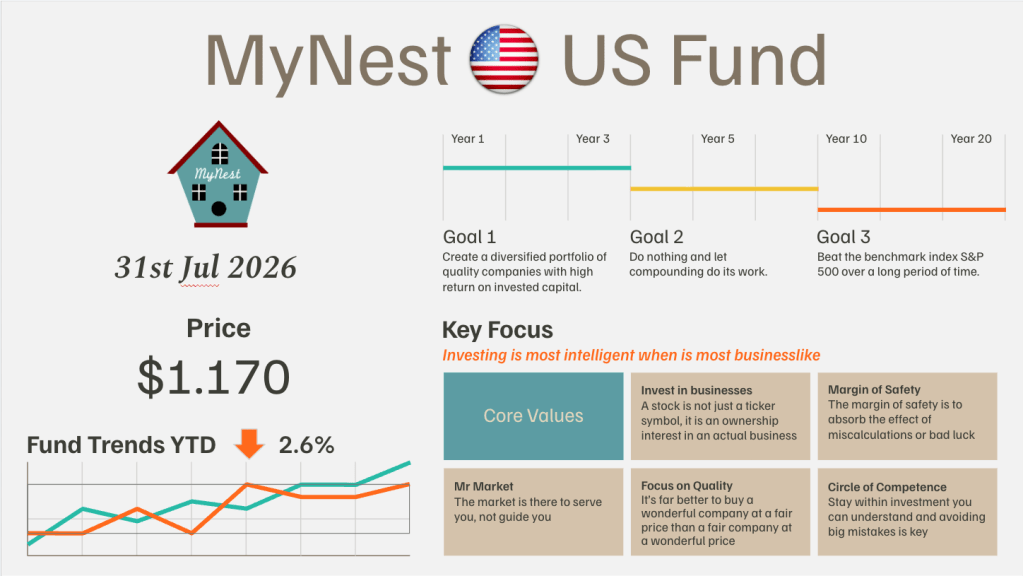
MyNest US Fund Jul 26
After spending a long period watching the artificial intelligence infrastructure build-out from the sidelines, we finally decided to join the party—albeit cautiously.
-
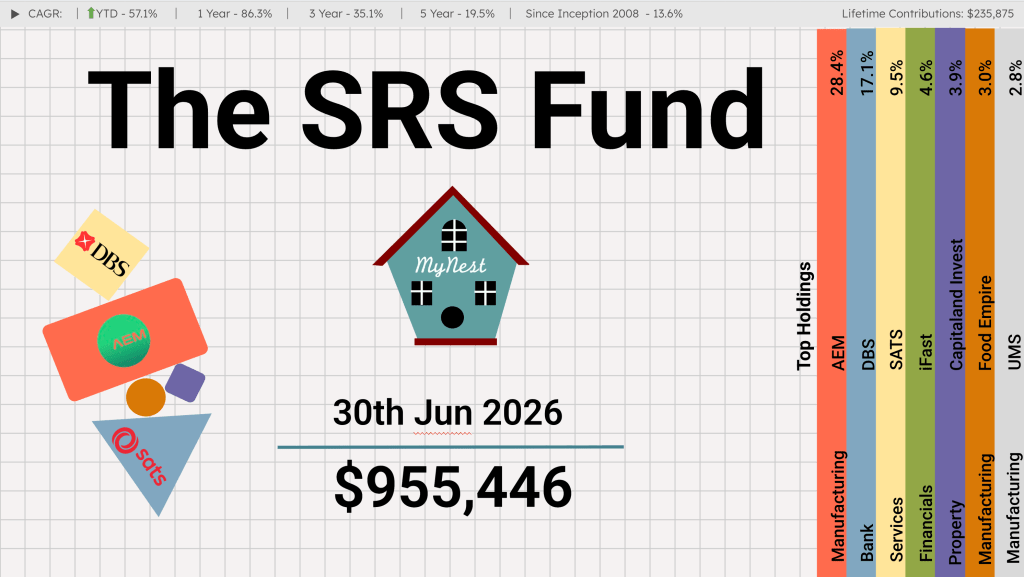
The SRS Fund Jun 2026
The month of Jun provided an important milestone in the Iran conflict. The agreement between the United States and Iran marked a significant step towards reducing geopolitical tension and reopening a clearer path for global energy flows
-
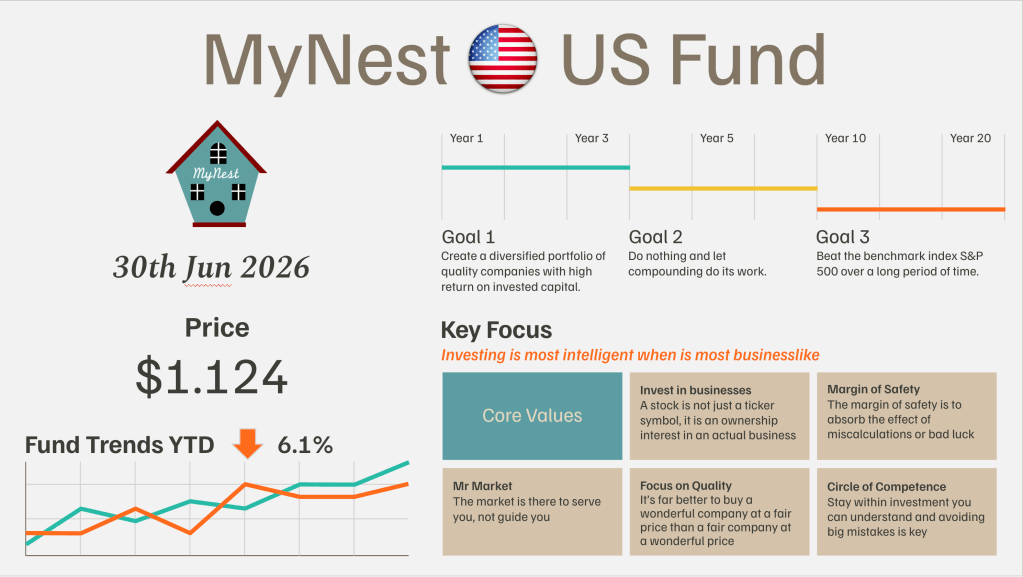
MyNest US Fund Jun 26
June was another remarkable month in the evolution of the global capitalism and the artificial intelligence investment cycle.
 MYNEST.SG