
Dear Investors,
The month of Sep brought together two developments that matter to our portfolio: Further progress in the field of AI and a sharp increase in long-term interest rates.
Meta’s launch of Muse provided encouraging evidence that its investment in AI is producing useful products. At the same time, rising bond yields reminded us that better businesses do not automatically translate into higher share prices. The price investors are prepared to pay for future earnings also matters.
For this month’s update, I want to focus on the US ten-year Treasury yield—why it deserves our attention, how it affects the businesses we own, and what it means for our investment decisions.
Why the Ten-Year Rate Matters
The US ten-year Treasury yield rose from 4.75% on 31 August to 5.29% on 30 September, an increase of 0.54 percentage points, or 54 basis points, in one month. That is a meaningful change in the return available from US government debt.
When people discuss interest rates, much of the attention goes to the Federal Reserve’s next decision. However, the Fed’s policy rate and the ten-year Treasury yield are different things.
For equity investors, the ten-year yield is an important reference point when assessing the return we require from owning a business.
When government bonds offer a higher yield, shares face greater competition for investors’ money. Investors may demand a higher expected return from equities, which can mean paying a lower price for the same future earnings. This relationship helps explain why a company can report satisfactory business results while its share price struggles.
A simple illustration shows the effect. A hypothetical $100 received ten years from now is worth approximately $46 today when discounted at 8%. At 9%, it is worth about $42. The future payment has not changed, but its present value has fallen.
These are illustrative required returns, rather than forecasts for our portfolio. They demonstrate why the price we pay remains so important.
What Higher Rates Mean for MyNest US Fund
Our technology and software holdings face a higher valuation hurdle.
Alphabet, Meta, Amazon and our software businesses have opportunities to grow their future earnings. However, higher required returns reduce what investors may pay today for that growth. Where substantial investment is needed upfront, we must also examine how much cash ultimately remains for shareholders
Property and other businesses that depend on financing face greater pressure.
Higher long-term yields can increase borrowing costs for households and companies. This matters for housing affordability, refinancing and the returns available from new projects. For holdings such as NVR and Brookfield, we need to consider both operating performance and the financing behind it
Our insurers can benefit from better reinvestment opportunities.
Markel and Berkshire Hathaway invest substantial sums alongside their insurance operations. Higher yields can improve the income earned as money is reinvested, although the benefit depends on the maturities they own. Existing bond prices can fall as yields rise, and Berkshire’s Treasury-bill income is particularly sensitive to shorter-term rates. Their reporting illustrates why we should distinguish investment income from changes in investment values.
Our 5.66% cash position also gives us flexibility to respond when valuations become more attractive. The interest earned on that cash depends on where it is held; it should not be confused with the ten-year Treasury yield.
The practical response is to test our investments against less favourable financing conditions and more demanding valuations. A sound investment should have a reasonable case even if interest rates remain elevated.
Meta: Our Investment Thesis Is Taking Shape
Meta, representing 4.86% of the portfolio, provided one of the month’s more encouraging business developments.
Meta introduced Muse, a personal AI agent powered by Muse Spark. Meta describes it as capable of carrying out tasks such as organising plans, researching purchases and booking travel, with access through its own app and WhatsApp.
For me, this is an encouraging sign that our patience with Meta is beginning to pay off in the development of the business. Its AI spending is producing capabilities that could make its products more useful in everyday life.
Meta already has established relationships with consumers and businesses. My view is that this distribution gives it an opportunity to introduce AI services through familiar channels and build usage over time.
The announcement of Muse for Small Business on 29 Sep made the commercial opportunity more tangible. Meta outlined connections to business tools, Facebook and Instagram accounts, and advertising accounts. Helping businesses manage work and reach customers could strengthen Meta’s existing commercial relationships. That is an investment opportunity we can understand, although its eventual financial contribution remains uncertain.
Muse strengthens the case for Meta’s AI opportunity. The next test is whether adoption produces durable revenue and cash flow sufficient to justify the capital committed.
Fund Performance
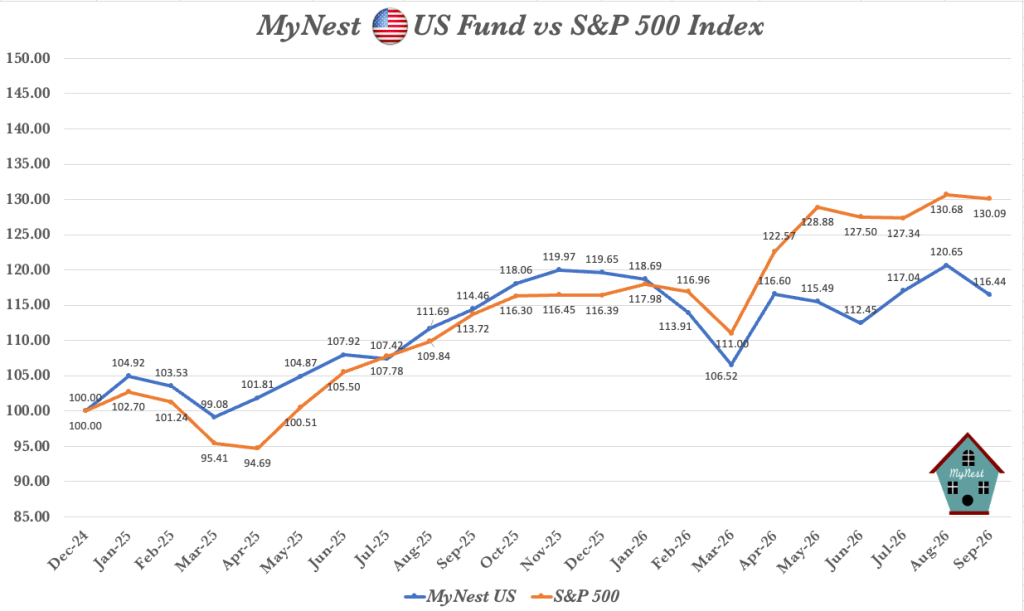
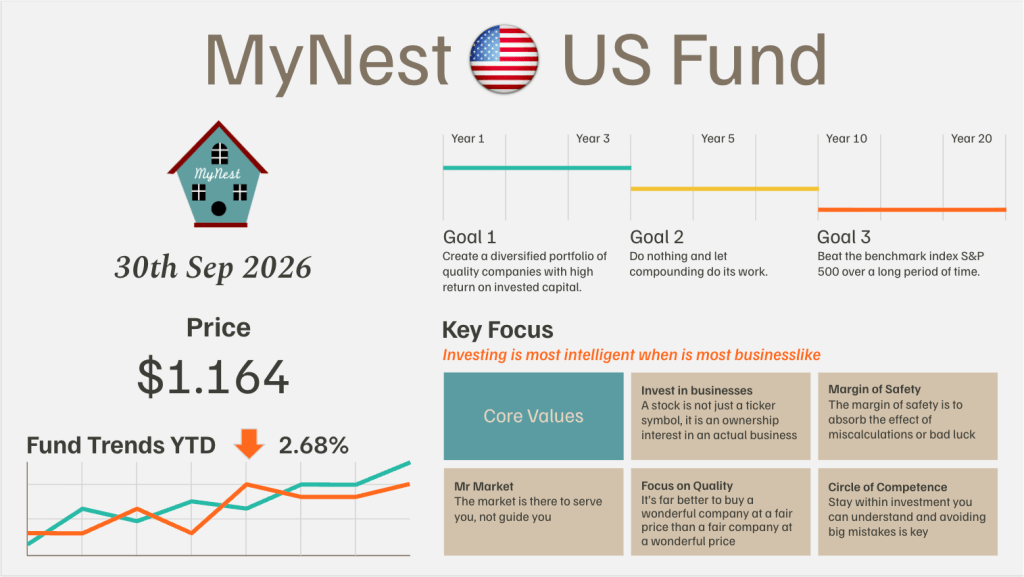
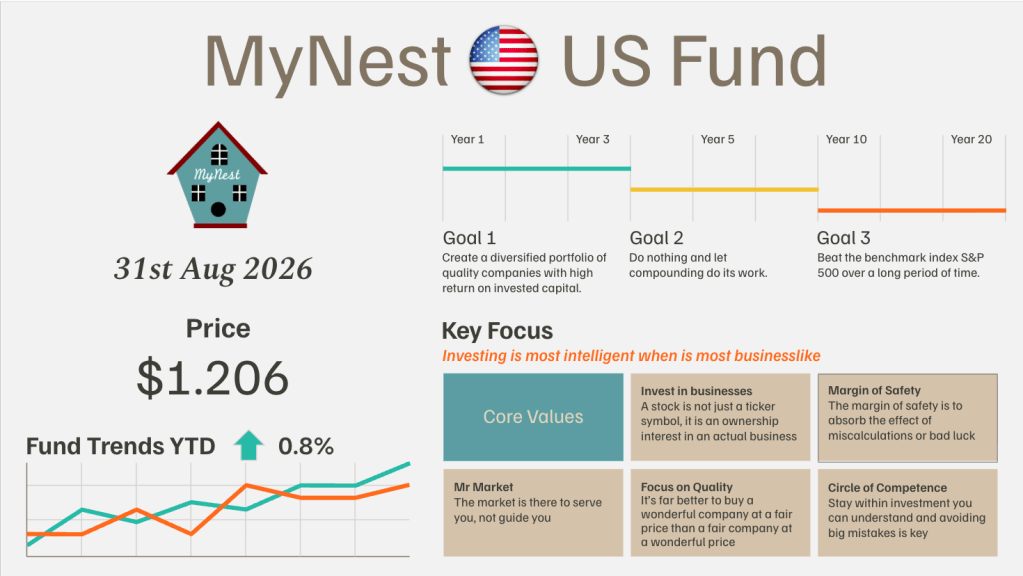
MyNest US Fund closed at a reported price of $1.206 at the end of Aug, recording its second consecutive monthly gain.
| Period | MyNest US Fund | S&P 500 |
|---|---|---|
| August 2026 | -3.49% | -0.45% |
| Year to date | -2.68% | +11.77% |
| Since inception in December 2024 | +16.44% | +30.09% |
The fund underperformed the benchmark by approximately 3.04% during September. Our cumulative return since inception now trails the S&P 500 by 13.65%
This is a disappointing result. Rising yields provide relevant market context, but they do not by themselves explain our relative performance. We must continue examining our stock selection, portfolio concentration and the valuations at which we invest.
Portfolio Activity
During Sep, we added to our investments in Pabrai Wagons ETF and Brookfield.
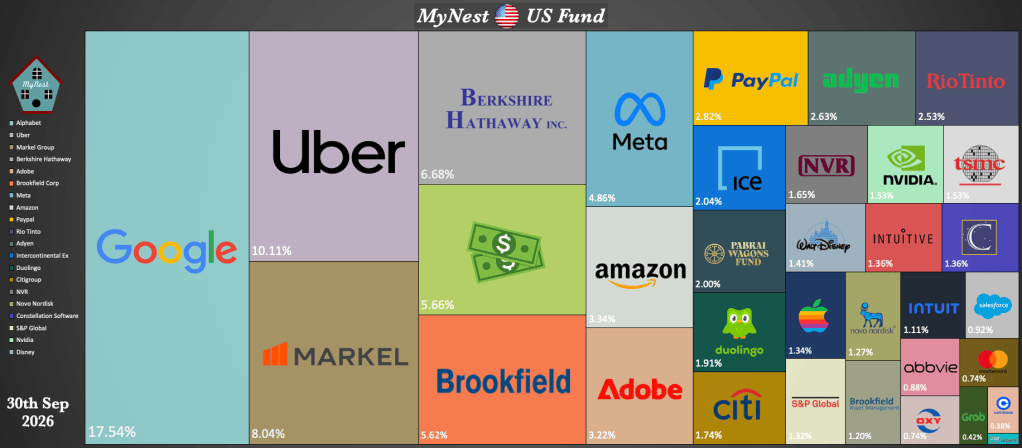
Pabrai Wagons ETF: WAGN fits our preference for patient ownership and disciplined capital allocation. However, its concentrated structure, cyclical holdings and exposure to overseas markets bring their own risks. Different holdings do not guarantee protection during a market decline. At 2%, the position gives these ideas room to contribute while keeping our exposure measured.
Brookfield: BN operates across three main areas: asset management, wealth solutions and operating businesses, including infrastructure, energy, private equity and real estate. This gives it several sources of earnings and opportunities to reinvest capital.
The asset management business earns fees for managing investors’ capital, together with performance-related income where applicable. Wealth solutions provides insurance and retirement products and invests assets to meet policyholder obligations. The operating businesses generate cash from the assets and services they provide.
Our separately listed Brookfield Asset Management holding gives us more direct exposure to the management business. The two positions are related: Brookfield Corporation itself owns a substantial interest in Brookfield Asset Management. We therefore need to assess our combined exposure.
What appeals to me is Brookfield’s ability to invest across different markets and improve the businesses it owns. Higher rates can create opportunities to acquire assets from sellers under financing pressure.
They also create challenges for Brookfield itself. Refinancing costs, property valuations and the timing of asset sales remain important. Contracted revenues can provide resilience, but they do not remove financing risk.
Our addition reflects confidence in Brookfield’s ability to allocate capital over time. That confidence must continue to be supported by cash generation and sensible returns on new investments.
Segment Chart
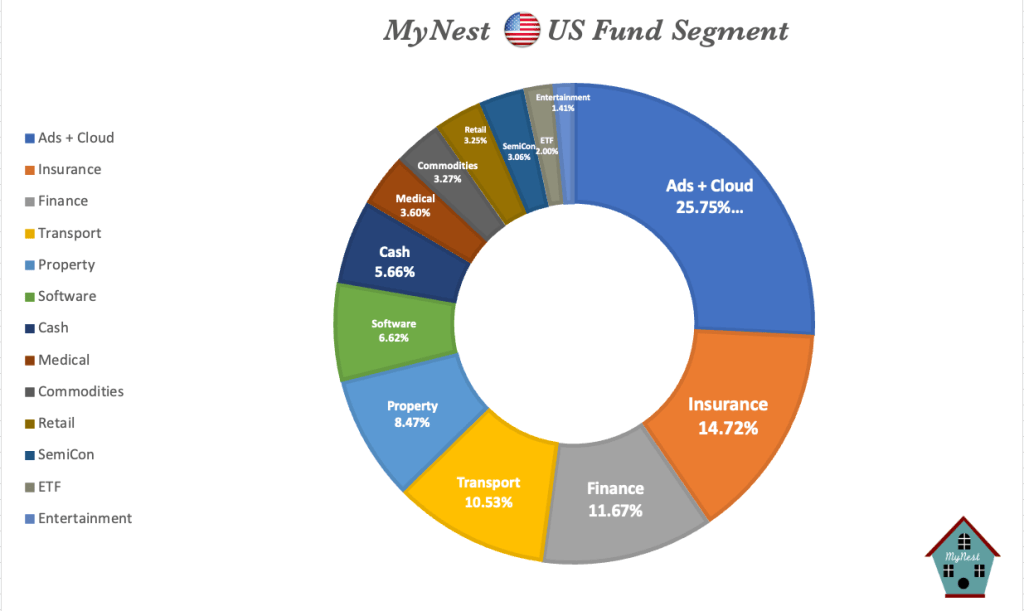
Under our portfolio classification, Ads + Cloud remained the largest segment at 25.75%, followed by Insurance at 14.72%, Finance at 11.67% and Transport at 10.53%
Property accounted for 8.47%, Software for 6.62% and Cash for 5.66%. Our ETF allocation stood at 2.00%
These categories help us describe the portfolio, although several holdings operate across more than one industry. Brookfield and Berkshire are particularly clear examples.
Closing Thoughts
Sep reinforced the importance of considering business progress and valuation together.
Meta’s Muse launch gives us further evidence of what its AI investment might achieve. Our additions to WAGN and Brookfield reflect our interest in businesses and managers capable of putting capital to productive use.
Meanwhile, a ten-year Treasury yield above 5% raises the standard against which we should assess those opportunities. Future growth must translate into cash, financing must remain manageable, and the purchase price must leave room for an attractive return.
Our task is to apply that discipline consistently, including when the portfolio falls behind its benchmark.
Thank you for your continued trust and support.
-
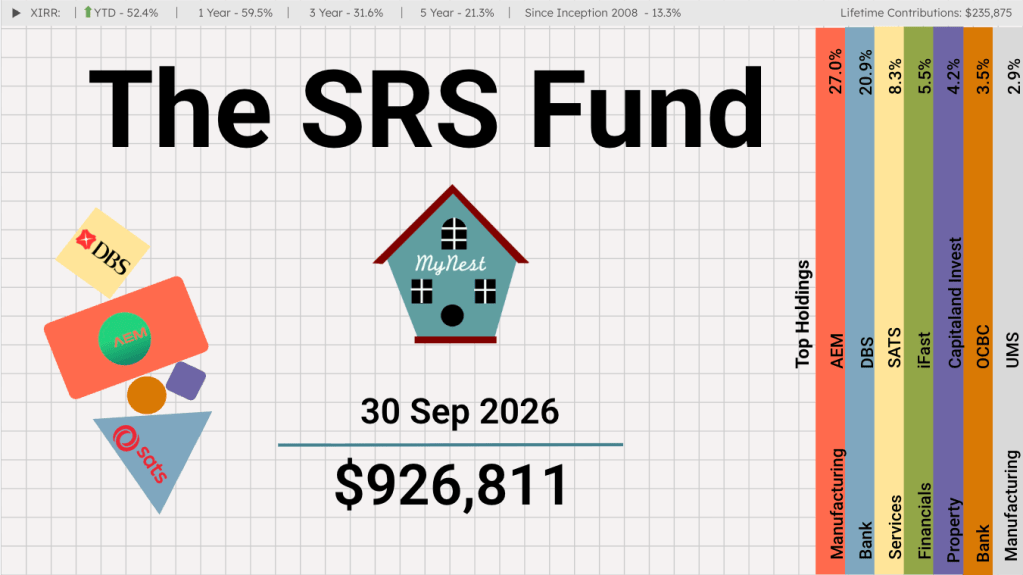
The SRS Fund Sep 2026
Sep brought a modest recovery in the SRS Fund, but it also left me thinking more carefully about how much of Singapore’s current economic and market strength is connected to the AI investment cycle.
-
MyNest US Fund Sep 26
The month of Sep brought together two developments that matter to our portfolio: Further progress in the field of AI and a sharp increase in long-term interest rates.
-

The SRS Fund Aug 2026
Aug’s economic update provided another reminder of how closely Singapore has become connected to the global investment in AI and semiconductors.
-
MyNest US Fund Aug 26
The idea behind the “SaaSpocalypse” was simple: if artificial intelligence could write software, generate content and complete business tasks, what would happen to the software companies charging customers to do those things?
-
The SRS Fund Jul 2026
For much of 2026, the market’s attention has been firmly fixed on AI, semiconductors and anything connected to the massive build-out in computing infrastructure.
-
MyNest US Fund Jul 26
After spending a long period watching the artificial intelligence infrastructure build-out from the sidelines, we finally decided to join the party—albeit cautiously.

