
Dear Investors,
October brought together two developments that deserve our attention: the continued divergence between our portfolio and the S&P 500, and Big Tech’s substantial earnings alongside increasingly demanding capital expenditure.
Our recent performance has been disappointing. However, I continue to believe that several businesses we own have characteristics that could become more valuable during a broader market correction.
For this month’s update, I want to focus on antifragility—why it matters, how it relates to our holdings, and why cash generation remains central to assessing the businesses we own.
Why Antifragility Matters
An antifragile business can use difficult conditions to strengthen its competitive position and improve its future earning power.
A market correction can create opportunities for businesses with available capital. Acquisitions become cheaper, competitors may reduce investment, and buying back undervalued shares can increase the ownership interest of remaining shareholders.
The advantage depends on having both the financial capacity to act and the discipline to invest well.
This is an important part of my thinking about MyNest US Fund. I want us to own businesses that can continue operating and investing through uncertainty, with managers capable of turning disruption into opportunity.
I believe a broader correction, particularly one involving a reassessment of expensive growth expectations, could create conditions for our portfolio to outperform the S&P 500 and narrow the performance gap.
That remains an investment thesis to be tested. Its success depends on the nature of the correction, the performance of our businesses and the valuations at which we own them.
What Antifragility Means for MyNest US Fund
Our insurance holdings provide several sources of earnings and opportunities for reinvestment.
Markel, Berkshire Hathaway and Chubb together represented 17.70% of the portfolio at the end of October.
Profitable underwriting can support the accumulation of investment capital. When attractive investments become cheaper, insurers with sufficient financial capacity may be able to improve their future returns.
Markel’s latest results provide an encouraging example of operating resilience. Its third-quarter insurance combined ratio was 92%, indicating profitable underwriting, while group adjusted operating income increased 14% to US$707 million. Investment-market movements nevertheless continued to affect reported earnings.
Our capital allocators may find better opportunities when markets become less accommodating.
For holdings such as Berkshire, Markel and Brookfield, I am interested in management’s ability to direct capital towards attractive long-term returns.
Lower asset prices can improve the economics of acquisitions and investments. Brookfield’s discussion of its diversified funding sources and ability to invest through market cycles illustrates this potential advantage. Financing discipline remains essential, particularly when borrowing conditions become more demanding.
Our technology holdings must demonstrate that growth creates satisfactory returns on capital.
Alphabet, Meta and Amazon have substantial opportunities, but those opportunities increasingly require large investments upfront.
For these businesses, resilience will depend partly on how effectively today’s infrastructure spending translates into future cash generation.
Our portfolio therefore combines different approaches to creating value. The task is to assess their underlying economics and shared risks, rather than assume that different industry labels provide protection.
Big Tech: Earnings and Cash Flow Under the Spotlight
Alphabet, Meta and Amazon together accounted for 21.84% of the portfolio at the end of October. Their latest results make the distinction between earnings and cash flow particularly relevant.
All three reported substantial operating profits and positive operating cash flow in the third quarter. However, capital expenditure pushed their free cash flow below zero.
| Company | Q3 operating profit | Q3 operating cash flow | Q3 free cash flow |
|---|---|---|---|
| Alphabet | US$40.58bn | US$42.29bn | −US$9.07bn |
| Meta | US$12.99bn | US$32.79bn | −US$2.12bn |
| Amazon | US$28.08bn | US$42.42bn | −US$33.46bn* |
Capital expenditure uses cash upfront, while much of its cost is recognised gradually through depreciation. Substantial accounting profits can therefore coexist with negative free cash flow.
This spending can create considerable value if the eventual returns justify the investment. For shareholders, the questions are how much additional earning power it will produce, how long that will take and how much continuing expenditure will be required.
My interest in these businesses remains. Their established products, customer relationships and distribution give them opportunities to commercialise AI.
However, strong demand and revenue growth must eventually support satisfactory returns on the capital committed. That is the next stage of the investment thesis we need to monitor.
Fund Performance
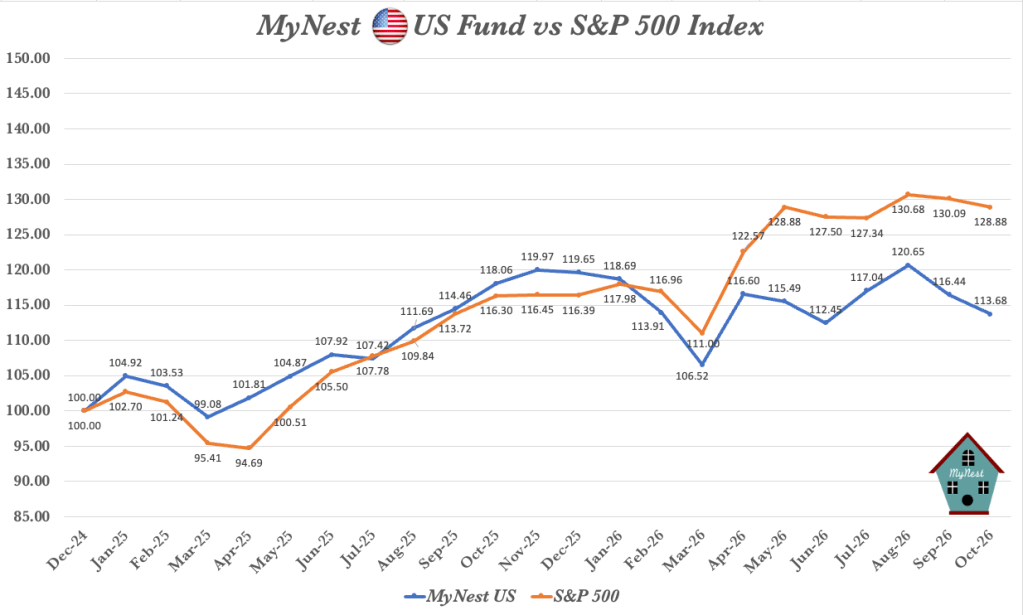
MyNest US Fund ended October at an indexed value of 113.68, down from 116.44 in September. The S&P 500 declined from 130.09 to 128.88.
| Period | MyNest US Fund | S&P 500 |
|---|---|---|
| October 2026 | −2.37% | −0.93% |
| Year to date | −4.99% | +10.73% |
| Since inception in December 2024 | +13.68% | +28.88% |
The fund underperformed the benchmark by approximately 1.44 percentage points during October. Our cumulative return since inception now trails the S&P 500 by 15.20 percentage points.
October did not demonstrate the downside resilience I am seeking. We must continue examining our stock selection, concentration and purchase valuations.
I remain confident in the potential of our businesses, while recognising that this confidence must ultimately be supported by investment results.
Portfolio Activity
During October, our additions were Chubb, Wise and Citigroup.
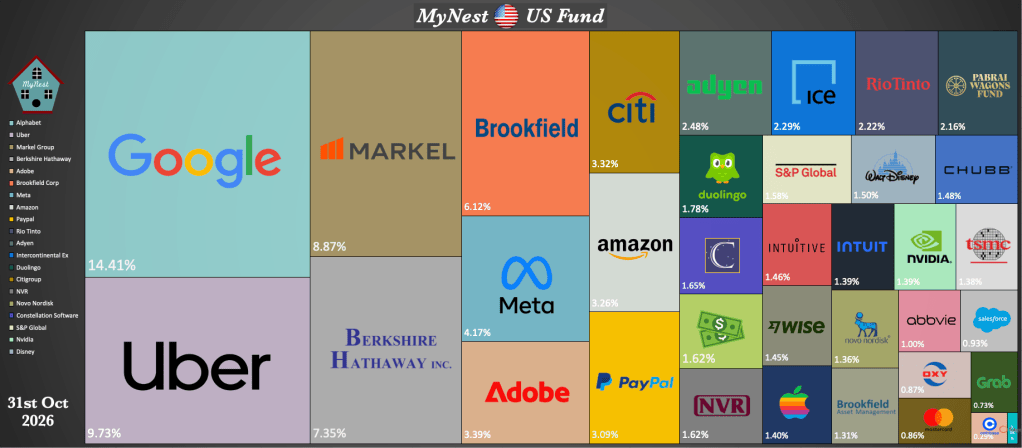
Chubb adds to our insurance exposure alongside Markel and Berkshire Hathaway.
Its third-quarter results showed US$2.06 billion of property and casualty underwriting income and a combined ratio of 84.1%, indicating profitable underwriting. Pre-tax net investment income reached US$1.79 billion. These provide two identifiable sources of earnings, although catastrophe losses and investment-market movements remain important risks.
This combination of underwriting and investment income fits the portfolio’s focus on businesses capable of earning and reinvesting through different conditions.
Wise gives us exposure to international payments and the infrastructure supporting the movement of money.
Its FY2026 results reported approximately 19 million active customers and US$243.5 billion of cross-border volume, increases of 21% and 31%, respectively. These figures demonstrate continued adoption of its services.
Citigroup adds exposure to banking and financial services, with an investment case that depends on operating performance, capital discipline and credit quality.
Third-quarter revenue increased 8% to US$23.8 billion, while Services revenue grew 15%. The company returned US$4.1 billion through common dividends and share repurchases. These are encouraging developments, although the results also included a higher provision for credit losses.
A bank remains sensitive to economic conditions. Our assessment must therefore consider the quality of its earnings and its capacity to absorb losses alongside the opportunity for improved shareholder returns.
Segment Chart
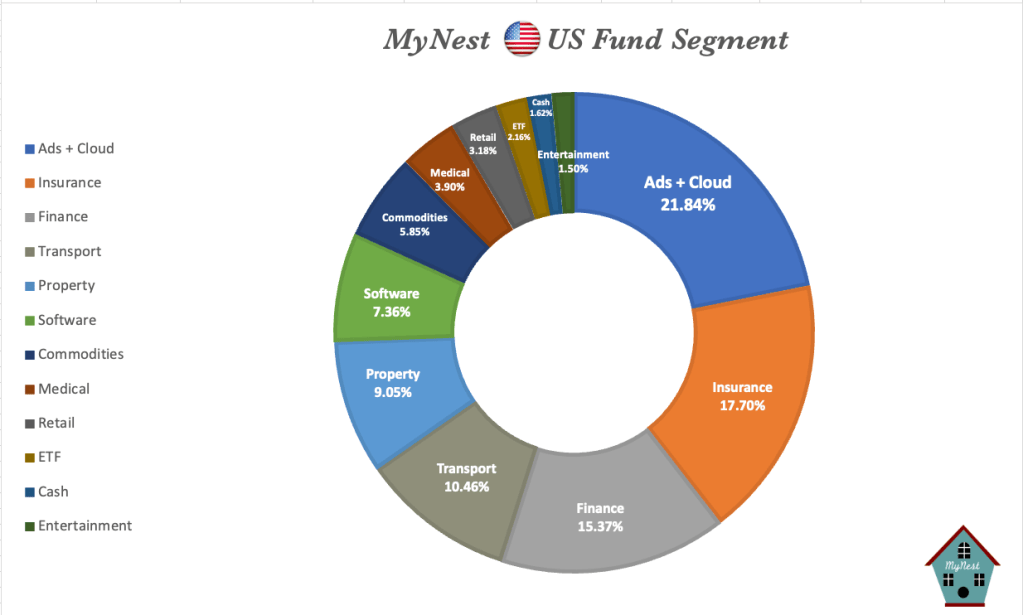
Under our portfolio classification, Ads + Cloud remained the largest segment at 21.84%, followed by Insurance at 17.70%, Finance at 15.37% and Transport at 10.46%.
Property accounted for 9.05%, Software for 7.36% and Commodities for 5.85%. Medical represented 3.90%, Retail 3.18%, ETF 2.16% and Entertainment 1.50%.
Cash stood at 1.62%, leaving limited immediate capacity for substantial new purchases.
These categories help describe the portfolio, although several holdings operate across multiple industries. We also need to distinguish the financial resources inside our companies from cash available directly to the fund.
Closing Thoughts
October reinforced the importance of assessing earning power, investment requirements and financial flexibility together.
Our additions to Chubb, Wise and Citigroup bring exposure to different sources of business activity. Meanwhile, Big Tech’s results remind us that substantial profits can come with equally substantial demands on cash.
I believe our portfolio has businesses capable of using difficult conditions to improve their long-term position. If that strength becomes apparent during a broader correction, it could help us outperform and narrow the gap with the S&P 500.
Our responsibility is to keep testing that belief against the evidence. We must remain disciplined about valuation, attentive to financial commitments and willing to reassess when business performance falls short.
I would like to thank you for your continued trust and support despite the underwhelming results.
-
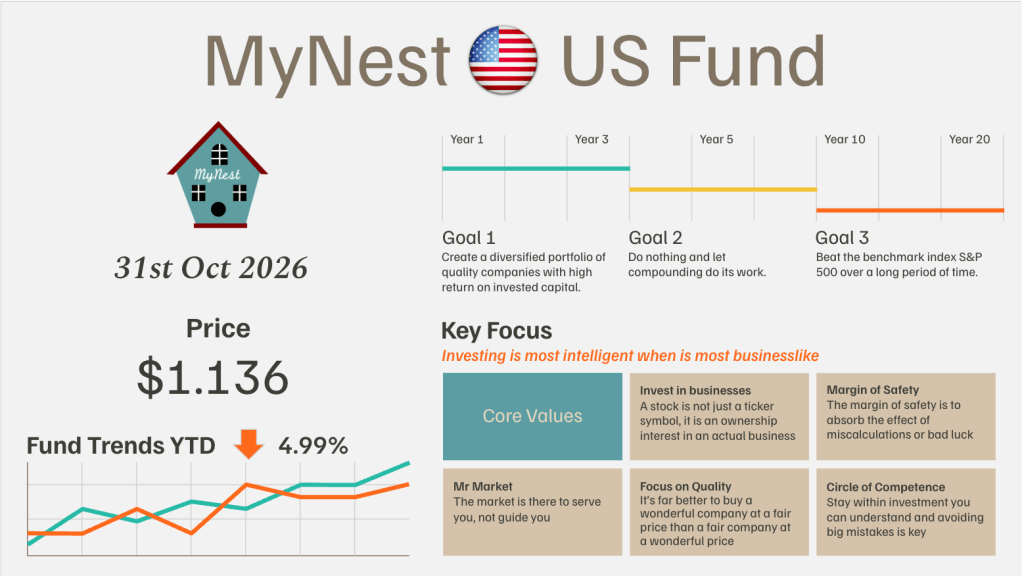
MyNest US Fund Oct 26
October brought together two developments that deserve our attention: the continued divergence between our portfolio and the S&P 500, and Big Tech’s substantial earnings alongside increasingly demanding capital expenditure.
-
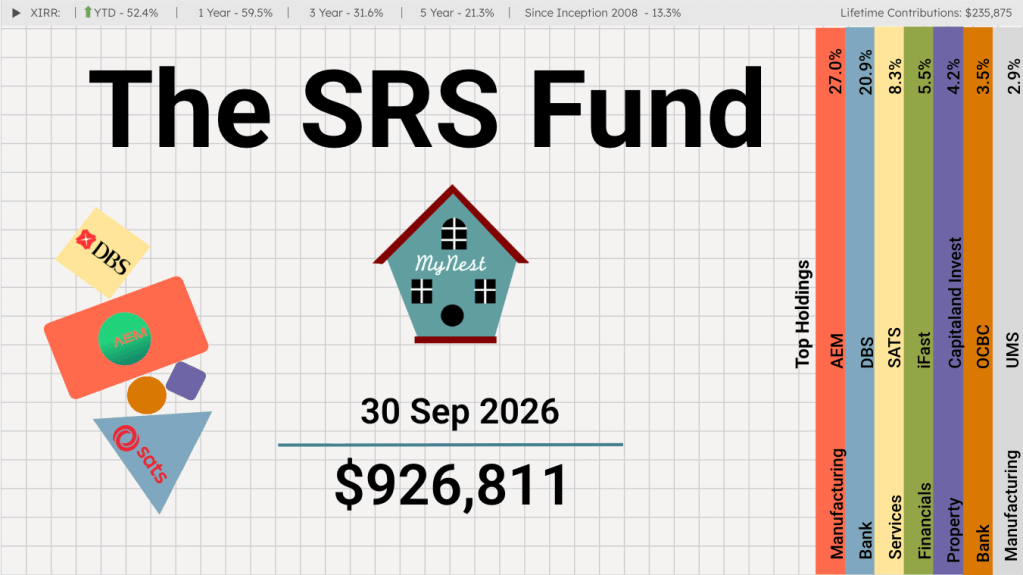
The SRS Fund Sep 2026
Sep brought a modest recovery in the SRS Fund, but it also left me thinking more carefully about how much of Singapore’s current economic and market strength is connected to the AI investment cycle.
-
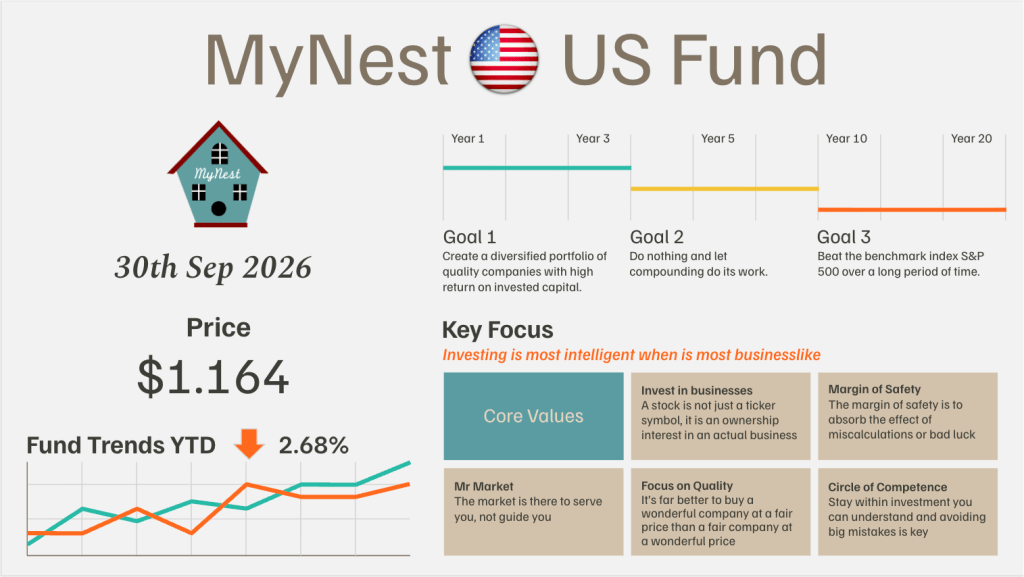
MyNest US Fund Sep 26
The month of Sep brought together two developments that matter to our portfolio: Further progress in the field of AI and a sharp increase in long-term interest rates.
-

The SRS Fund Aug 2026
Aug’s economic update provided another reminder of how closely Singapore has become connected to the global investment in AI and semiconductors.
-
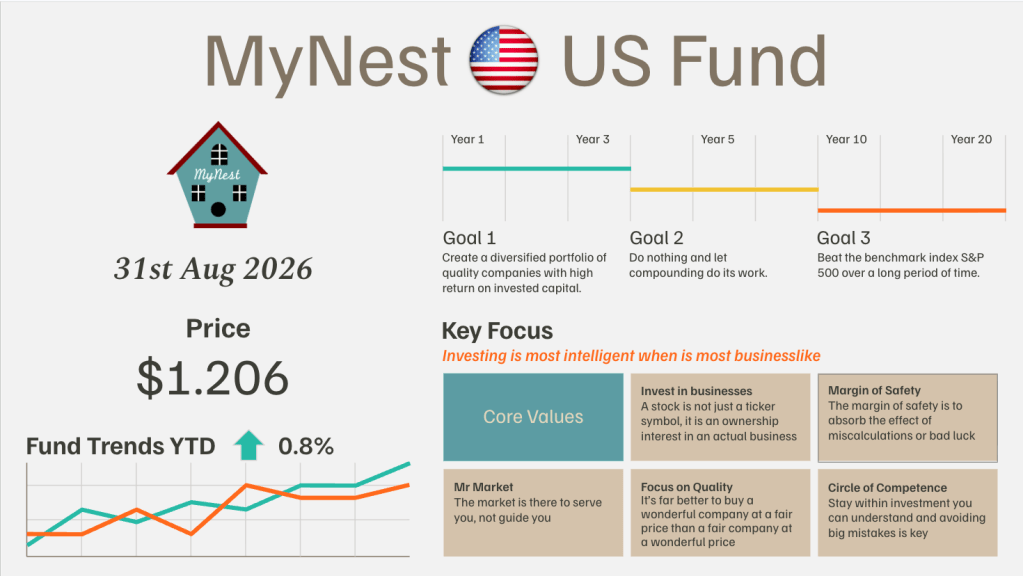
MyNest US Fund Aug 26
The idea behind the “SaaSpocalypse” was simple: if artificial intelligence could write software, generate content and complete business tasks, what would happen to the software companies charging customers to do those things?
-
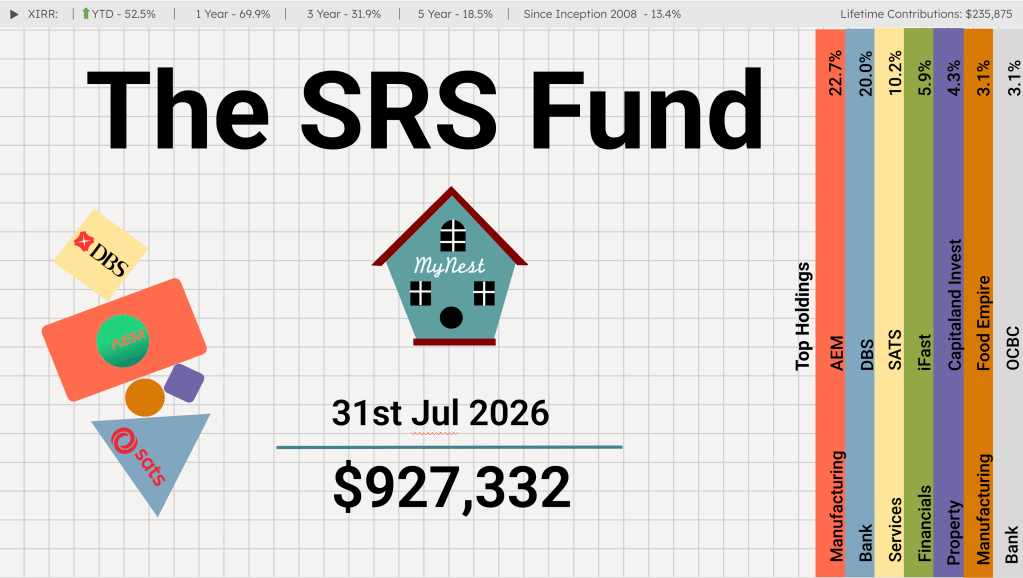
The SRS Fund Jul 2026
For much of 2026, the market’s attention has been firmly fixed on AI, semiconductors and anything connected to the massive build-out in computing infrastructure.

